Apple’s Foldable iPhone Puts the Real Contest Beyond the Hinge
The iPhone Duo’s flexible 7.6-inch display will command attention, but Apple’s harder test is turning screen space, silicon, software and privacy infrastructure into AI that changes how people use a phone.
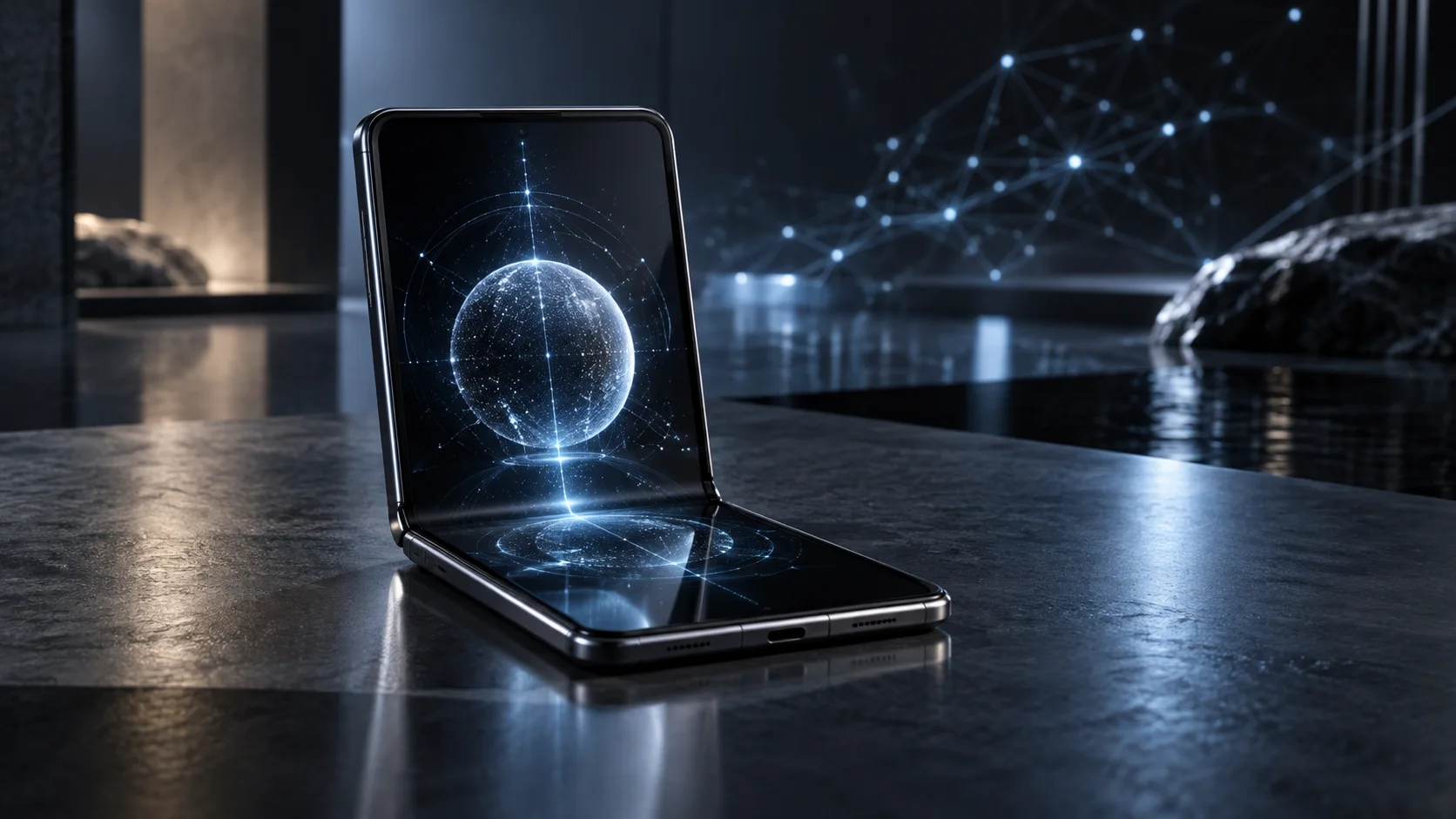
Apple’s first foldable iPhone is an obvious hardware story. The more consequential question is whether the fold changes what people actually do with artificial intelligence on a phone.
At its September 2026 event, Apple announced the iPhone Duo alongside the iPhone 18 Pro, Apple Watch Series 12, Apple Watch Ultra 4 and AirPods 5. Apple calls the Duo its first foldable iPhone and says it has the largest display ever offered on an iPhone. AP independently reported on September 9 that Apple’s new chief executive had unveiled a lineup that included the foldable device.
The specifications give Apple a clear launch narrative. The company lists a 7.6-inch inner Super Retina XDR display, support for several physical orientations and Split View multitasking. It also presents the vapor-cooled A20 Pro chip and its dual 16-core Neural Engine as hardware designed for intensive AI workloads. Preorders are due to begin October 16, with availability scheduled for October 23.
Those are Apple’s claims, not independent test results. Yet they frame the strategic proposition: the hinge attracts attention, while the combination of screen, silicon, operating-system integration and privacy architecture must justify the form factor over time. If Apple succeeds, the Duo could make AI more visible and more useful in routine mobile work. If it does not, the product may be remembered primarily as a novel piece of hardware.
A larger canvas for AI
Phone-based AI often has to operate inside a narrow interface. A person can ask for help, inspect a result or act on a suggestion, but fitting all three into a conventional phone screen can be awkward. A foldable display potentially creates room to keep context and action visible together.
Apple says the Duo can be used in landscape, portrait, closed, seated and standing orientations. It also supports Split View multitasking. Those configurations could matter more than the raw diagonal measurement, potentially keeping source material visible beside writing assistance, a photo edit or an automated action. These are possibilities, not proven habits.
The distinction is important. More screen space does not automatically make AI useful. Apple has to design interactions that explain what the system is doing, preserve relevant context and let users correct or reject its output without turning every task into a sequence of prompts. A flexible display could reduce friction by showing more of that process. It could also add complexity if apps behave inconsistently across orientations or if AI controls compete with ordinary touch interfaces.
Apple’s listed Intelligence features provide a starting point: photo editing, Writing Tools, Visual Intelligence, contextual suggestions and Shortcuts automation. The company also says its Siri AI supports open-ended conversation, retrieval of personal context, actions in apps, world knowledge, a dedicated app, camera-based visual intelligence and writing assistance. Apple says the service is rolling out in English and that usage limits may apply.
Taken together, the ambition is broader than a chat window. Apple is describing AI as a layer that can understand a request, draw on personal context and help complete an action. The Duo’s larger inner display may offer a better place to show the information used, the proposed result and the app in which the action will occur. Whether that makes the experience reliably better remains unproven.
Silicon is only part of the system
Apple says the Duo uses an A20 Pro chip cooled by a vapor system, with a dual 16-core Neural Engine intended for intensive AI workloads. This matters because responsive on-device processing can support features without making every interaction depend on a remote server. But Apple has not supplied independent benchmark evidence in the editor packet, so the chip’s real-world advantage cannot be assessed here.
That integration also raises the standard Apple must meet. A system that draws on personal context or takes actions in apps needs to be predictable. People need to understand which information is being used, whether processing occurs on the device or elsewhere, and what will happen before an action is completed. Convenience can become a liability if an assistant retrieves the wrong context or acts in the wrong place.
Battery life will also shape whether the promised experience feels practical. Apple advertises up to 31 hours of video playback on the inner display and up to 44 hours on the outer display. Those figures are marketing claims for video playback, not measurements of sustained AI use. They therefore cannot establish how the Duo will perform during repeated model inference, camera-based analysis or multitasking. Independent testing will be needed after release.
Privacy becomes part of performance
Apple’s privacy architecture is central to its attempt to distinguish an integrated AI system. The company says Private Cloud Compute extends the security and privacy model of its devices to cloud inference when a workload is too complex for on-device models.
In June 2026, Apple said it was extending Private Cloud Compute to third-party data centres in collaboration with Google and NVIDIA on Google Cloud Platform. That move makes cloud partners part of the infrastructure behind at least some complex workloads, even as Apple presents PCC as preserving its device-level security and privacy approach.
For consumers, the practical issue is not the architecture’s name but whether they can trust the boundary between local and cloud processing. Apple’s claim is significant, but the supplied sources do not independently verify the operation or security of PCC. Buyers and researchers will need evidence about how the expanded system behaves in practice, particularly when personal context, images or app actions are involved.
Privacy is therefore not separate from AI performance. An assistant can be fast and capable yet fail as a product if users hesitate to give it useful context. Conversely, a system that earns trust but cannot reliably complete everyday tasks will not change behaviour. Apple’s contest is to deliver capability, clarity and restraint at the same time.
What consumers should expect
For buyers, the Duo presents two overlapping propositions. One is tangible: a foldable phone with a 7.6-inch inner display and multiple ways to position it. The other is less settled: a device on which AI becomes a practical part of writing, photography, visual search, suggestions and automation.
Apple lists a Grade 5 titanium frame and hinge cover, a scratch-resistant coating on the inner display, Ceramic Shield on the front and back, and IP68 water and dust resistance. These specifications are relevant because a fold introduces moving parts and an exposed inner surface. They remain manufacturer claims; they do not substitute for long-term durability evidence.
Apple also claims 3,000 nits peak brightness for the inner display, but the packet provides no independent measurement or comparison.
Language and service limits could be more immediate constraints. Siri AI is rolling out in English, according to Apple, and usage limits may apply. That matters even for an English-language audience in the United States and Europe: a staged rollout or capped service can make the experience less consistent than a hardware launch suggests. The supplied information does not specify the timing of every feature, regional availability beyond the stated English rollout, or the limits users may encounter.
Developers face a new interface problem
For app developers, the Duo adds more than another screen size. Apple’s listed orientations, Split View support and proposed AI actions across apps create a wider set of interface states to consider. An app may be used closed, unfolded, alongside another app or with the device positioned rather than held.
The opportunity is simultaneous context; the risk is inconsistency among postures. If layouts, controls or app actions change unpredictably, users may avoid the more ambitious features.
Developers will also have to decide where AI adds genuine value. Writing assistance, photo editing, visual intelligence, contextual suggestions and Shortcuts automation can reach into many categories of app. But adding an AI control is not the same as improving a task. The best integrations will likely be those that shorten a known workflow and keep the user able to inspect the result.
Apple’s system-level position may simplify access to common capabilities, but it can also deepen dependence on Apple’s rules and interfaces. That is part of the ecosystem lock-in concern: when a person’s workflows rely on device-specific app actions, personal context and automation, moving to another platform may become more difficult. This is a strategic risk to consider, not a quantified outcome established by the supplied sources.
The competitive pressure shifts
For smartphone competitors, a foldable iPhone raises the cost of competing on hardware spectacle alone. Rivals may need to respond not just with flexible displays, but with a coherent relationship among form factor, AI processing, applications and cloud infrastructure.
A larger screen is a category idea. Integrated AI behaviours, developer tools and privacy assurances demand coordination across a platform.
Apple faces the same challenge in reverse. Vertical integration is not proof of useful integration. Competitors with different hardware, software and cloud strategies may find faster ways to deliver particular AI features. Apple must show that its control of the stack produces an experience people prefer, not merely a longer list of components it controls.
Privacy claims may become another competitive battleground. By linking on-device processing with Private Cloud Compute, and by extending PCC to third-party data centres with Google and NVIDIA on Google Cloud Platform, Apple is arguing that complex cloud inference can fit within its privacy model. Competitors will have reason to articulate their own boundaries between device and cloud processing. Users will still need verifiable evidence rather than slogans from any company.
The near-term counterargument
There is a strong case that AI will not decide the Duo’s early reception. The fold itself is new to the iPhone, and buyers may focus first on hardware novelty, durability, price and the costs of committing further to Apple’s ecosystem.
Durability is especially difficult to establish at launch. Apple lists premium materials, protective coatings and IP68 resistance, but a specification sheet cannot show how a hinge or inner display will fare after extended daily use. The supplied packet also gives no price, so it is not possible to judge the trade-off between the Duo’s capabilities and its purchase cost.
AI may be secondary for another reason: the experience is still rolling out. Apple says Siri AI is rolling out in English and warns that usage limits may apply. Until the features are broadly available and independently tested, consumers may rationally judge the Duo on display utility, battery behaviour, comfort and reliability instead.
Hardware can win attention, while integrated AI must prove its value through repeated, ordinary use.
What to watch next
The first test is whether Apple’s AI features are available consistently when the Duo reaches customers on October 23. The second is whether developers adapt apps to the device’s orientations and Split View in ways that make the larger screen more than a viewing surface. The third is whether independent testing supports Apple’s durability, brightness and battery claims, including performance under AI-heavy use.
Most of all, watch behaviour rather than demonstrations. The strategic victory would not be a foldable iPhone that can run impressive AI features. It would be a phone on which people routinely use AI to understand, create and complete tasks because the larger screen, system integration and privacy design make those actions easier to trust and control.
The hinge is the invitation. Everyday usefulness will decide whether the Duo changes the smartphone contest.
Signal & Syntax will continue to update this guide as products, access and practical evidence change.