The Will to Power Behind the Cloud: Nietzsche on AI Data Centers
AI appears weightless on screen, but its power is built from land, water, electricity and political silence. Nietzsche helps reveal who commands the infrastructure.
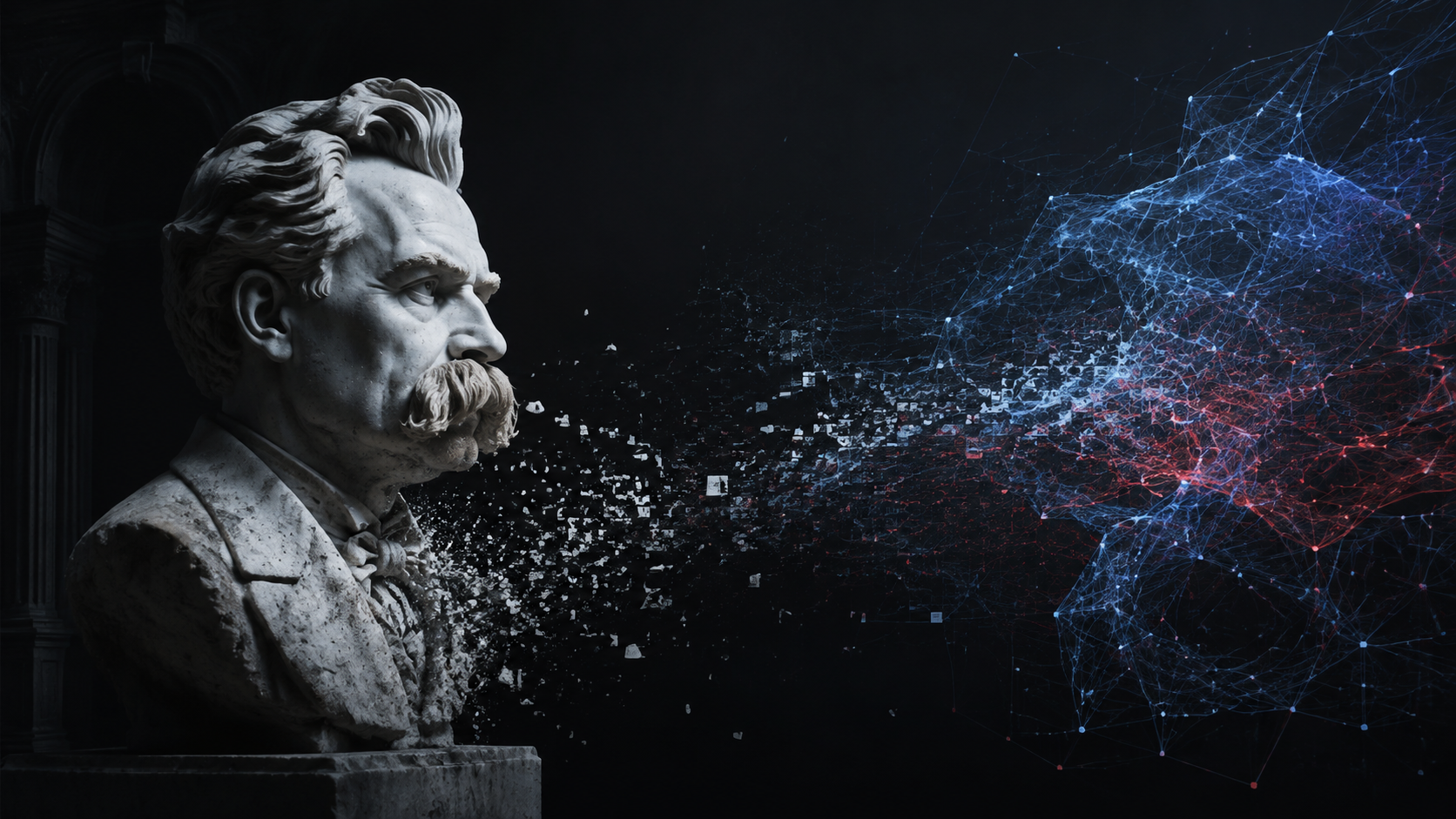
Artificial intelligence arrives to most people as a clean interface: a blank box, an instant answer, a service that seems to live nowhere. Its material foundation is far less ethereal. Data centers require enormous investments, electrical capacity, water, land and durable political agreements.
Recent reporting on a proposed US Environmental Protection Agency rule raised a democratic concern: some information about data-center projects and their environmental impact could become harder for the public to obtain. Whether the final policy takes that form or not, the dispute reveals a central fact. The “cloud” is a struggle over territory and visibility.
Nietzsche offers a useful lens here—not because every cable is a will to power, but because infrastructures embody arrangements of command. Who defines the project, who bears its cost, who receives its benefits and who is allowed to know?
01Power prefers to look inevitable
In “On Self-Overcoming,” Nietzsche connects interpretation, valuation and command. Life does not merely adapt to a neutral world; it organizes, ranks and imposes form. Modern infrastructure does the same politically. A grid connection, tax agreement or water allocation turns one possible future into the ordinary background of life.
The most effective power rarely announces itself as domination. It appears as necessity: demand is rising, capacity must expand, delays are impossible. Once the project is described as inevitable, local resistance can be treated as ignorance and public review as friction.
That rhetoric conceals choices. Electricity directed to computation cannot be used elsewhere at the same moment. Public incentives committed to one industry are unavailable to another. Noise, land use and water pressure are not abstractions for nearby residents.
02Ressentiment is not a substitute for evidence
Nietzsche's analysis of ressentiment also cautions the opposition. Communities can rightly demand disclosure and fair terms, but anger becomes politically weak when it needs a villain more than an accurate account.
Not every data center is identical. Local grid conditions, cooling systems, energy contracts and community benefits differ. A Nietzschean critique should resist moral theater from both sides: corporate narratives in which scale is destiny, and activist narratives in which every technical project is proof of corruption.
In *Genealogy* I.10, reactive valuation begins with the enemy. A stronger democratic response begins with its own affirmative standard: reliable energy, accountable development, local bargaining power and public access to material facts.
03The machine and the disappearance of authorship
In *The Wanderer and His Shadow* §288, Nietzsche describes the machine as impersonal. It removes individual pride, recognizable error and the sense that a maker inhabits the work. AI infrastructure extends that impersonality beyond products into decisions.
When approvals are divided among utilities, contractors, regulators and confidential commercial agreements, no single actor appears responsible. The system simply advances. That is precisely why transparency matters. It restores names, choices and promises to a process that otherwise presents itself as automatic.
Nietzsche did not oppose machines because they saved labor. He warned that convenience can be purchased too dearly. The contemporary price should be measured not only in megawatts and water, but in diminished civic agency.
04What a stronger bargain would require
A serious public compact for AI infrastructure would publish energy and water estimates, disclose public subsidies, identify who pays for grid upgrades, establish enforceable community benefits and make emergency or confidentiality exceptions narrow and reviewable.
This is not a demand that every technical detail become public. It is a demand that secrecy not become the default language of power.
The important Nietzschean question is not whether data centers are “good” or “bad.” It is whether the communities around them remain capable of willing their own future. Infrastructure worthy of the name should enlarge collective capacity without making its builders politically invisible.
The cloud is not above us. It is installed among us. Once we see that, the debate changes from admiration of scale to responsibility for form.
05Primary texts and event sources
Nietzsche, *Thus Spoke Zarathustra*, “On Self-Overcoming,” eKGWB/Za-II-Ueberwindung ↗.
Nietzsche, *On the Genealogy of Morality* I.10, eKGWB/GM-I-10 ↗.
Nietzsche, *The Wanderer and His Shadow* §288, eKGWB/WS-288 ↗.
Associated Press: EPA proposal and public access to data-center information ↗.
06Editorial note
This is a contemporary application of Nietzsche's concepts, not a claim about a position he held on digital infrastructure.