What Nietzsche Can Teach Us About AI and Modern Life
Artificial intelligence may liberate human creativity—or turn us into more comfortable, predictable and interchangeable versions of ourselves.
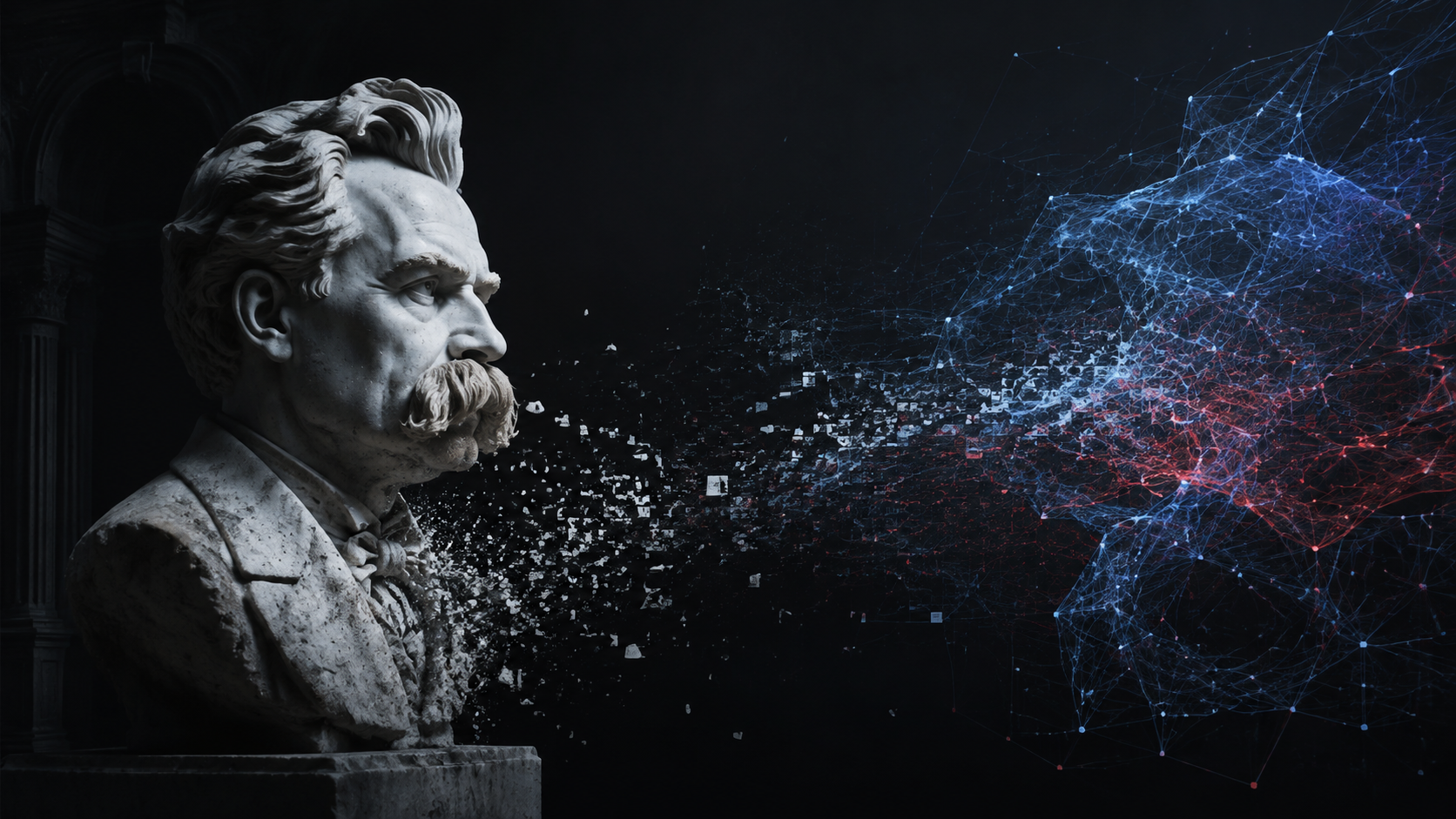
Artificial intelligence is usually discussed through a familiar set of questions.
Will it replace workers? Can machines become conscious? Which industries will be transformed next? How should governments regulate increasingly powerful models?
Friedrich Nietzsche would probably begin somewhere else. He would ask: What kind of human being is this technology producing?
Does AI help people develop their own judgment, create new values and move beyond inherited limitations? Or does it encourage them to seek convenience, safety and ready-made answers?
Nietzsche died more than a century before generative AI appeared. We should not pretend that he predicted large language models or recommendation algorithms. Yet his ideas about the “last man,” herd conformity, mechanized labor, active forgetting and self-overcoming offer a sharp framework for understanding AI’s influence on modern life.
From this perspective, artificial intelligence is neither a savior nor a demon. It is an amplifier. It can expand the abilities of a disciplined creator or magnify intellectual laziness. It can expose us to unfamiliar perspectives or manufacture an endless supply of average opinions. The deepest danger is not that machines will become human. It is that humans will reshape themselves into creatures that machines can easily replace.
01The AI-powered “last man”
In the prologue to *Thus Spoke Zarathustra*, Nietzsche introduces one of his most disturbing figures: the “last man.”
The last man does not seek self-overcoming. He avoids danger, difficulty and ambitious goals. He values comfort, security, health and small pleasures above everything else. He believes that suffering is merely a technical problem to be eliminated.
“We have invented happiness,” Nietzsche’s last men declare. Their happiness, however, is purchased by abandoning aspiration. They no longer ask what humanity could become. They want a world without serious risk, conflict or spiritual tension—a world in which everyone desires roughly the same things.
The last man is not necessarily ignorant. He may be informed, practical and highly competent at managing everyday life. What he lacks is the desire to create something greater than himself.
Artificial intelligence fits this psychological landscape almost perfectly. It can summarize a book we did not read, compose a message we did not want to think through, and produce an immediate answer to a question we were unwilling to struggle with. Recommendation systems can keep us inside carefully optimized zones of emotional comfort, continuously supplying content similar to what we already enjoy.
None of these conveniences is inherently degrading. The decisive question is whether removing difficulty has become our highest definition of progress.
Learning requires more than obtaining the correct answer. Writing is not simply the production of grammatical sentences. Thinking cannot be reduced to the efficient rearrangement of information.
When AI is used primarily to avoid effort, the result may be a technologically advanced version of Nietzsche’s last man: informed but incurious, productive but without purpose, entertained but unable to create.
The danger is subtle. AI does not order us to abandon our ambitions. It simply makes passive living easier, smoother and more attractive.
Source: Nietzsche, *Thus Spoke Zarathustra*, Prologue §5, eKGWB/Za-I-Vorrede-5 ↗.
02When average opinion becomes personal thought
AI’s second major influence concerns the standardization of language and opinion.
Nietzsche observed that when people are suddenly asked for their opinion, the first answer that comes to mind is rarely their own. It is usually the conventional opinion of their class, position, background or community. A genuinely individual judgment takes time. It requires experience, resistance, reflection and the willingness to become uncomfortable.
Large language models are trained to identify and reproduce patterns across enormous bodies of human writing. They are extraordinarily capable of generating clear, plausible and socially recognizable responses. But this ability creates a risk: the most statistically likely answer can begin to masquerade as a personal thought.
If users stop checking sources, challenging assumptions or introducing their own experience, AI-generated consensus may quietly replace judgment. People will continue expressing opinions, but those opinions may increasingly emerge from the same linguistic and conceptual machinery.
The result is not silence. It is a flood of polished sameness. Business posts follow identical structures. Cover letters express the same ambitions. News summaries adopt the same balanced tone. Essays present the same arguments in slightly different arrangements.
There may be more published language than at any previous moment in history, yet less evidence that a particular person needed to say these particular words.
Nietzsche’s discussion of consciousness in *The Gay Science* makes this development especially interesting. He argues that conscious thought and language developed under the pressure of communication. When unique inner experiences are translated into shared signs, they are simplified and generalized so that other people can understand them.
Language connects individuals, but it also translates individual experience back into what Nietzsche calls the perspective of the herd. AI dramatically scales this process. It converts complex experience into language that is immediately legible, reusable and socially acceptable. What is gained in accessibility can be lost in individuality.
The central intellectual danger of generative AI is therefore not a shortage of content. It is the disappearance of personality beneath an abundance of competent language.
Nietzsche’s challenge to the AI user would be simple: Are you using the model to clarify your own thought, or to avoid developing one?
Sources: Nietzsche, *Human, All Too Human* §286 and §571, eKGWB/MA-286 ↗, eKGWB/MA-571 ↗; *The Gay Science* §354, eKGWB/FW-354 ↗.
03What machines remove from work
Nietzsche directly considered the effect of machines on human labor. In *The Wanderer and His Shadow*, he describes the machine as impersonal. Mechanization removes the individual pride, imperfections and recognizable qualities that once belonged to a piece of work.
Handmade objects carried signs of their makers. Their irregularities were part of their humanity. Mechanized production offered efficiency and consistency, but Nietzsche warned that the convenience of labor-saving machinery could be purchased at too high a price.
The observation applies powerfully to generative AI. Imperfection is often evidence that a person was present. An awkward sentence, an unusual visual decision or an argument that refuses to become perfectly efficient may carry the creator’s history and taste.
AI can eliminate many such imperfections. But in doing so, it may also remove the evidence of authorship.
Inside organizations, this appears as the standardization of professional communication. Reports, emails, advertisements and presentations become more polished, while the identity of the person behind them becomes less important. Workers may be liberated from repetitive composition, yet lose their sense of ownership over the finished result.
We therefore need to distinguish between two kinds of automation.
The first automates mechanical tasks so that people can devote more energy to judgment, invention and meaningful decisions. This kind of automation can increase human power.
The second automates not only execution but also purpose and evaluation. The worker no longer knows why the task matters, how the result should be judged or what goal the system is pursuing. This is not liberation. It is a deeper form of depersonalization.
Nietzsche did not romanticize exhausting labor. In *Daybreak*, he argued that the most gifted minds should not be consumed by the routine maintenance of political and economic machinery. A civilization wastes its most valuable resource when it spends human intelligence on tasks that do not require it.
This suggests a positive role for AI. Machines can absorb repetitive information work and return time to human beings. But the value of that liberation depends entirely on what happens next. Does the saved time support thought, craft and experimentation? Or does it merely produce higher output targets and more administrative work?
The important question is not how many hours AI saves. It is what those hours allow a person to become.
Sources: Nietzsche, *The Wanderer and His Shadow* §288, eKGWB/WS-288 ↗; *Daybreak* §179, eKGWB/M-179 ↗.
04An infinite memory—and the need to forget
AI is also an external memory system. It can store, retrieve and reorganize more information than any individual could master. We no longer need to remember every fact or process every document from the beginning.
But Nietzsche’s account of memory suggests that remembering more does not automatically mean living better.
In *On the Genealogy of Morality*, he describes forgetting as an active and positive capacity. It is not simply a failure of memory. It is a gatekeeper that protects psychological order. Human beings need to close the doors and windows of consciousness for a while. Without this active forgetting, there would be no calm, present attention or space for something new.
This insight matters in an age of permanent information. Search engines, social platforms and generative models create an environment in which no inquiry ever needs to end. Every answer can be expanded. Every draft can produce ten alternatives. Every decision can be subjected to one more round of research.
We gain access to more information but may lose the ability to finish thinking and begin acting. A person who cannot filter, reject and forget becomes intellectually overwhelmed. Instead of serving human purposes, AI’s seemingly unlimited memory creates endless comparison, revision and hesitation.
AI literacy must therefore include more than prompting, retrieval and automation. It must include the discipline of exclusion: When should the model be closed? When is further generation no longer useful? Which sources do not deserve attention? When is an imperfect draft good enough to become an action?
Human agency is demonstrated not only by the ability to access information, but also by the ability to decide what will not be allowed into consciousness.
Source: Nietzsche, *On the Genealogy of Morality*, Second Essay §1, eKGWB/GM-II-1 ↗.
05Can AI become an instrument of self-overcoming?
Stopping at the claim that “AI makes people lazy” would turn Nietzsche into a simple anti-technology conservative. His philosophy is far more demanding than that. Nietzsche was not primarily interested in preserving traditional human habits. He was interested in whether human beings could overcome what they had already become.
In *Thus Spoke Zarathustra*, he describes three transformations of the spirit: the camel, the lion and the child.
The camel carries inherited burdens and established duties. The lion confronts the great dragon of “Thou shalt” and wins the freedom to say “I will.” The child represents a new beginning, play, creation and an affirmative relationship with life.
AI can participate in all three stages. It can become another burden carried by the camel: more content quotas, more performance metrics and a constant demand for efficiency.
It can also become a new dragon. Data, optimization and “best practices” begin telling people what they should write, what audiences should want and what forms of expression are most likely to succeed. In this form, AI does not help people discover their desires. It standardizes desire itself.
But AI can also become a tool in the hands of the lion and the child. A model can present opposing arguments, reveal weaknesses in a draft, remove repetitive labor and make experimentation less expensive. It can help creators test unfamiliar structures, encounter new knowledge and move beyond the limits of their initial training.
The condition is that the model must not receive final authority over value. AI can help us create. It cannot decide what is worth creating.
Source: Nietzsche, *Thus Spoke Zarathustra*, “On the Three Metamorphoses,” eKGWB/Za-I-Verwandlungen ↗.
06AI is a knowledge worker, not a value creator
In *Beyond Good and Evil* §211, Nietzsche distinguishes between philosophical workers and genuine philosophers. The philosophical worker organizes the values of the past. Such a person collects, compares, summarizes and makes previous knowledge manageable.
The genuine philosopher has a different responsibility. The philosopher determines the “where to” and the “what for.” Existing knowledge becomes material for creating a future.
This distinction offers one of the clearest ways to understand large language models. An AI system is an extraordinarily capable knowledge worker. It can organize historical material, compare perspectives, compress long documents and turn scattered information into useful forms.
But it cannot relieve human beings of the responsibility to determine what should matter.
A model can propose a strategy. It cannot decide which life is worth pursuing. It can optimize an article for engagement. It cannot decide whether engagement is the right purpose of writing. It can list available actions. It cannot assume moral responsibility for the action chosen.
When people treat AI as an answer machine, they gradually surrender their ability to formulate goals. When they treat it as material, a mirror and a hammer, it can expand the range of possible creation.
Source: Nietzsche, *Beyond Good and Evil* §211, eKGWB/JGB-211 ↗.
07Four abilities we should never outsource
A Nietzschean approach to AI would not demand that we reject technology. It would require us to evaluate every tool according to its effect on human agency.
1. The ability to set goals. AI can help design a route. It should not decide where a life is worth going.
2. The ability to evaluate. A model can produce alternatives, but people must still decide what is higher, better or worth pursuing.
3. The ability to resist the average. Users must return personal experience, taste and risk to their work instead of accepting the first fluent answer.
4. The ability to stop using the tool. Knowing when to close the model, think alone and permit difficulty to remain is an essential form of technological freedom.
Artificial intelligence will not automatically create Nietzsche’s higher human being. Nor will it inevitably produce the last man. It will amplify the direction already chosen by its users.
Those seeking comfort will receive unprecedented convenience. Those seeking conformity will gain an endless supply of acceptable answers. Those willing to experiment, take responsibility and create may gain one of the most powerful intellectual tools ever developed.
The future we should fear is not simply one in which AI awakens and conquers humanity. It is one in which humans, seduced by efficiency, gradually stop deciding what they want to become. In that future, machines would not need to seize control. We would have handed over judgment, memory, language and value one convenient step at a time.
Nietzsche’s most urgent question for the AI age is therefore not whether a machine can become human. It is whether human beings will still accept the most difficult and least automatable task of all: the responsibility to create themselves.
08Editorial note
Nietzsche did not write about artificial intelligence. This article applies concepts from his published works to contemporary technology and distinguishes those applications from Nietzsche’s original historical claims.