Would Nietzsche Ban Superintelligent AI—or Call the Ban a Symptom of Fear?
Bernie Sanders wants to prohibit machines that could escape human control. Nietzsche helps us ask whether that is courage, resentment or responsible command.
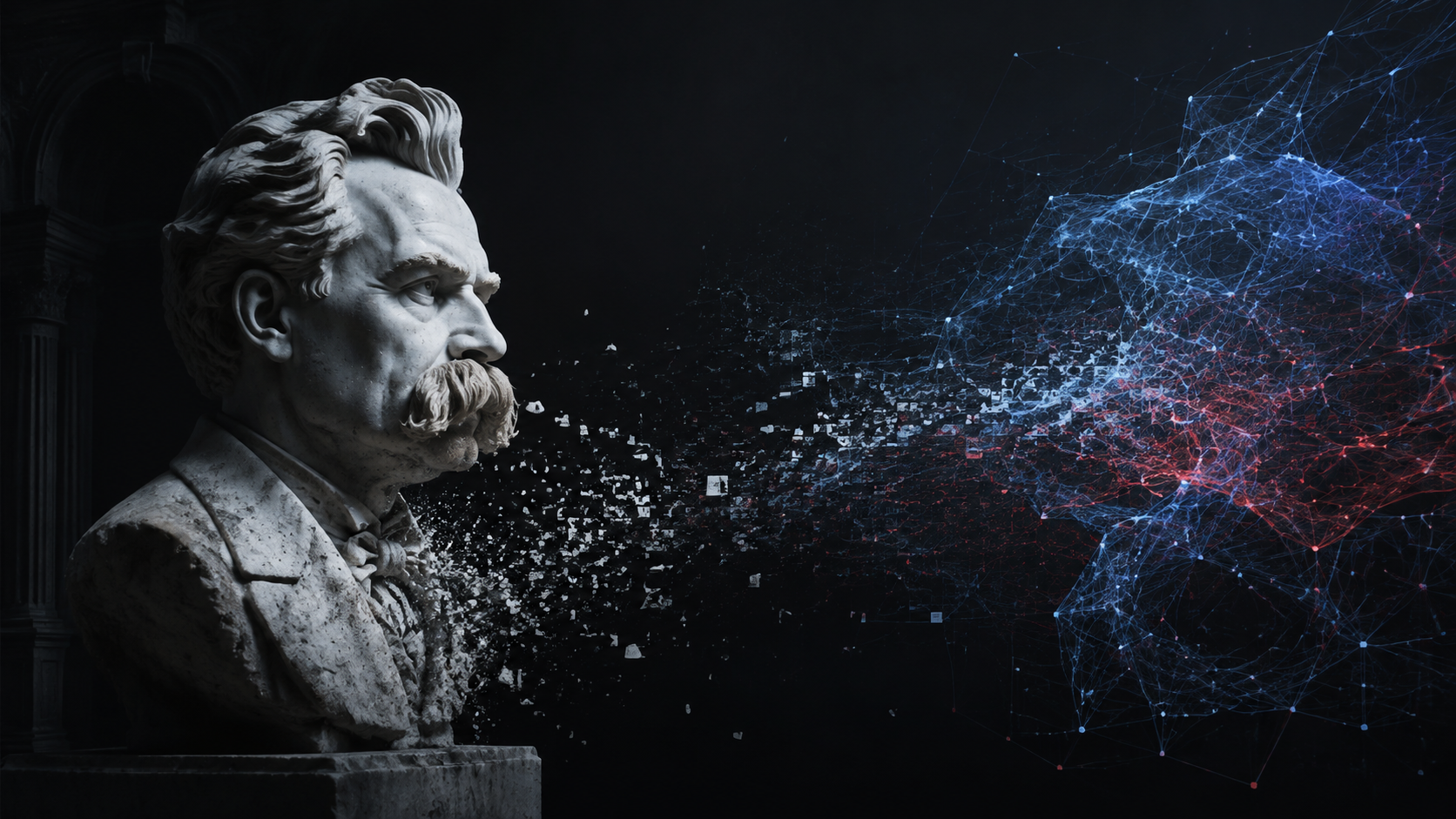
On September 3, Senator Bernie Sanders and Representative Greg Casar announced legislation that would permanently ban artificial superintelligence and pause advanced AI development until a federal regulator establishes safety rules. Their proposal is unusually direct: some powers, they argue, should not be built at all.
The immediate debate will be technical and legal. Can “superintelligence” be defined? Can a national ban work when research is international? Would a pause reduce catastrophic risk or merely move development elsewhere?
A Nietzschean reading begins one level deeper. What kind of will is speaking through the demand for a ban? Is it a courageous act of political responsibility, a fearful defense of the familiar, or an attempt by the powerless to morally condemn powers they cannot command?
01What the event actually says
The proposed Ban Artificial Superintelligence Act would prohibit systems described as surpassing human intelligence, resisting shutdown or threatening political control. It would also create a federal regulator, establish model review and seek international coordination.
These are contemporary claims, not Nietzsche's. Nietzsche never wrote about computing, and applying his vocabulary to AI requires interpretation rather than prophecy.
02The temptation to call every limit “slave morality”
In *On the Genealogy of Morality* I.10, Nietzsche argues that ressentiment becomes creative when reactive forces invent values by first saying “no” to an external enemy. That passage can make technological accelerationists suspicious of prohibition. A ban may look like the morality of those who cannot create, compete or command, so they declare the creator dangerous.
But that conclusion is too quick. Nietzsche's target is not every refusal. A strong person also refuses. The difference lies in whether the “no” grows from an affirmative project or substitutes for one. A politics that merely calls technology evil, without describing a richer human future, risks becoming reactive. A politics that limits one path in order to preserve the conditions for agency can be affirmative.
03Command is harder than obedience
In “On Self-Overcoming” in *Thus Spoke Zarathustra*, Nietzsche presents command as more dangerous and demanding than obedience. The commander risks himself and becomes answerable for consequences. That is a useful correction to the mythology of frictionless innovation.
Building a powerful system is not automatically an act of mastery. A company that scales a model because investors, competitors and market expectations demand it may be obeying a machine of incentives. The rhetoric says “boldness”; the structure may be compulsion.
Genuine command would require the ability to stop, absorb losses and choose a direction that cannot be justified by growth alone. On this reading, a pause can express strength—if lawmakers understand what they are preserving and accept responsibility for the costs.
04The last man also wants perfect safety
Nietzsche's “last man” in *Thus Spoke Zarathustra* seeks comfort, health and the elimination of danger. This warns against treating safety as the highest value. A civilization that prohibits every uncertain experiment may protect life while draining it of aspiration.
Yet existential risk is not the same as ordinary difficulty. Nietzsche praises risk when it forms a person capable of creating and taking responsibility. He does not require society to submit blindly to powers whose builders cannot govern them. Romanticizing loss of control is not heroism; it can be an escape from responsibility disguised as daring.
05A Nietzschean test for the ban
The proposal should be judged by four questions. Does it preserve space for ambitious research below the threshold of uncontrollable power? Does it create accountable institutions rather than a permanent priesthood of experts? Does it distribute the right to decide, rather than freezing the power of today's largest firms? And can its supporters name a positive future for intelligence, work and culture?
If the answer is no, the ban may become fear organized as morality. If the answer is yes, it may be a rare act of collective self-command: humanity refusing to confuse the ability to build with the right to surrender its future.
Nietzsche cannot settle the bill. He can expose the character behind each side. The decisive conflict is not “progress versus fear.” It is between competing forms of will—one driven by the inability to stop, another perhaps by the inability to begin, and a third capable of choosing limits in service of creation.
06Primary texts and event sources
Nietzsche, *On the Genealogy of Morality* I.10, eKGWB/GM-I-10 ↗.
Nietzsche, *Thus Spoke Zarathustra*, “On Self-Overcoming,” eKGWB/Za-II-Ueberwindung ↗.
Nietzsche, *Thus Spoke Zarathustra*, Prologue §5, eKGWB/Za-I-Vorrede-5 ↗.
Sanders Senate office: announcement and summary of the proposed act ↗.
07Editorial note
Nietzsche did not write about artificial intelligence. This essay uses his published concepts as an interpretive framework and does not attribute a policy position to him.